The Chartered Institute of Ecology and Environmental Management (CIEEM) has recently published updated guidelines for EcIA, which can be downloaded here:
The 1st edition Guidelines were originally published in 2006, and have become a cornerstone for professional ecological consultants since then.
Following only a quick read, my initial thoughts are that this new edition of the guidelines is an excellent update, providing a concise and well-written exposition of how EcIA should be undertaken.
I particularly like the Introduction section which defines the EcIA process and highlights the two most commonly used applications; providing input to Environmental Impact Assessment, and for demonstrating how projects accord with planning policy and legislation for non-EIA projects. It then summarises the general EcIA process and the various stages therein.
Following only a quick read, my initial thoughts are that this new edition of the guidelines is an excellent update, providing a concise and well-written exposition of how EcIA should be undertaken.
I particularly like the Introduction section which defines the EcIA process and highlights the two most commonly used applications; providing input to Environmental Impact Assessment, and for demonstrating how projects accord with planning policy and legislation for non-EIA projects. It then summarises the general EcIA process and the various stages therein.
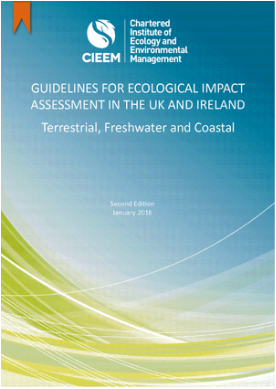
Having applied the EcIA process to numerous projects (both for EIA and non-EIA projects), I would highly recommend that this document be read by anyone commissioning professional ecologists, those actually required to undertake EcIA (who should be suitably qualified ecologists) and to those reviewing EcIA reports (such as planning officers and consultees).
These guidelines are also essential reading for students or graduates who aspire to be professional ecological consultants.
All in all, I am very impressed and applaud the various authors and contributors, who I know have put a great deal of time and effort into the production of these guidelines.
These guidelines are also essential reading for students or graduates who aspire to be professional ecological consultants.
All in all, I am very impressed and applaud the various authors and contributors, who I know have put a great deal of time and effort into the production of these guidelines.